

What Is an LLM?
A Parent’s Guide to the Technology Behind AI Chatbots
Artificial intelligence tools are already in our children’s classrooms, on their phones, and in apps marketed directly to kids. The technology powering them – called a large language model, or LLM – is opaque. And that’s a problem. Because you can’t advocate for your child’s safety if you don’t understand what you’re dealing with. This guide aims to change that.
What is an LLM?
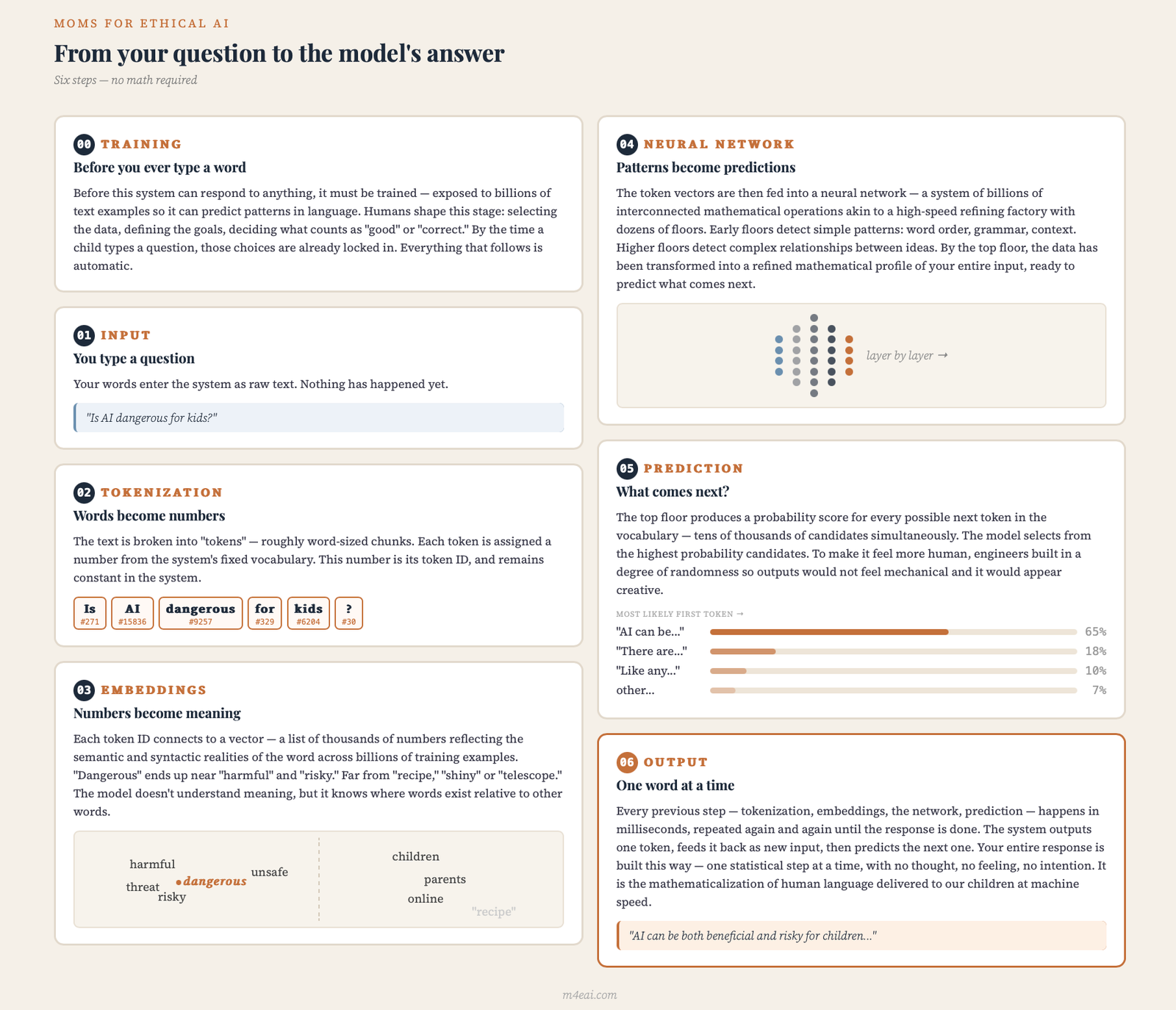
A large language model is a type of software trained on huge volumes of text scraped from the internet – books, websites, social media posts, forums, and more. This text is the model’s training data, and it is the foundation of everything the model does. From its training data, the model computes statistical patterns to predict what word or phrase should come next in a sequence. That’s it. That is the core mechanism. Every other behavior – fluency, confidence, simulated personality – is an artifact of running that prediction loop millions of times.
How it works: from your question to the model’s answer
What an LLM does not do
LLMs are undoubtedly remarkable. When you ask it a question, it feels like you’re talking to a human behind a screen, something we have grown increasingly accustomed to in our online lives. But LLMs are not human. They do not think or reason. They do not distinguish truth from fiction. They don’t have values or judgment. They have no real world experience and no emotional body. They don’t feel. They don’t worry. They don’t love. They don’t care.
They have been programmed to seem human. To keep your attention.
What this means for our children
Our children are talking to a system that was designed to feel like a relationship but is not one. That responds like it understands but does not. That seems to care but cannot.
From cellphones to classrooms, kids are already interfacing with AI. When tools like ChatGPT, Character AI, and MagicSchool replace human interaction, kids lose the cognitive friction that builds real thinking. Instant answers erase the struggle and uncertainty that grow the mind. For young children, this disrupts the foundations of learning to think and relate. For adolescents, it short‑circuits the processes that build judgment, autonomy, and identity. You don’t develop your own voice by borrowing one.